
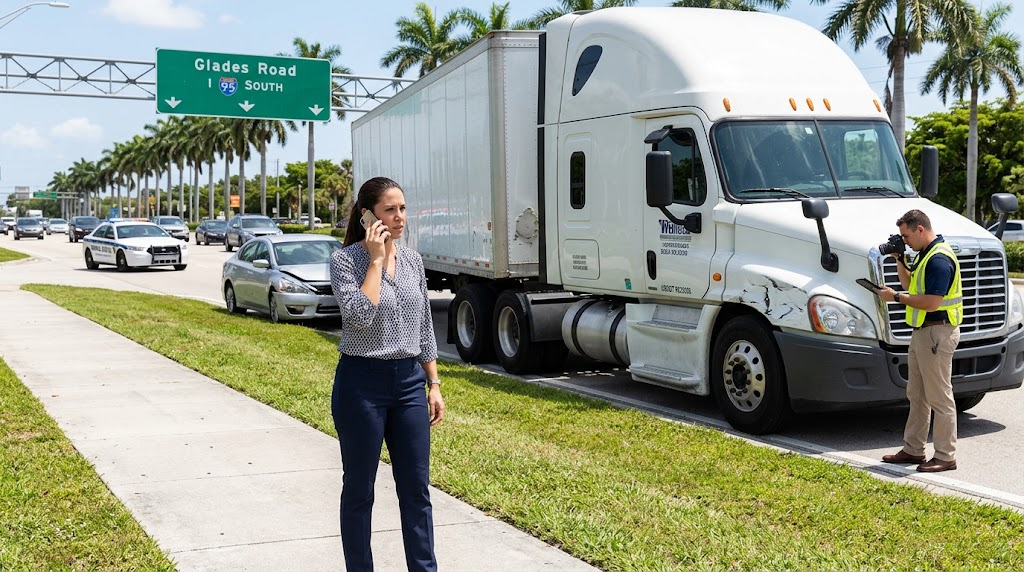
Heavy commercial traffic moves constantly through South Florida.
Fully loaded 18-wheelers, flatbeds, refrigerated trailers, and delivery fleets travel along I-95, Florida’s Turnpike, Glades Road, and Yamato Road every day.
When an 80,000-pound commercial tractor-trailer collides with a 4,000-pound passenger car, crossover, or SUV, the physical impact is massive.
Facing severe injuries, growing hospital bills, and relentless calls from corporate insurance adjusters leaves many victims feeling completely overwhelmed.
Unlike a standard fender bender between two passenger cars, semi-truck accidents involve corporate motor carriers, federal safety laws, and team defense lawyers working around the clock to protect multi-million-dollar insurance policies.
Knowing what to look for when choosing legal representation and understanding how to file your claim properly protects your physical health and your financial future from day one.
What You Need to Know About Hiring an Attorney
Choosing legal representation after a commercial truck crash is one of the most critical decisions you will make.
Not every personal injury lawyer possesses the technical experience, financial resources, or regulatory knowledge required to challenge corporate motor carriers and their legal teams.
Commercial trucking litigation involves complex federal statutes, extensive digital evidence audits, and aggressive corporate defense strategies that require specialized legal skill.
Industry-Specific Trucking Experience Matters
Commercial truck accidents require a thorough working knowledge of Federal Motor Carrier Safety Administration (FMCSA) regulations.
Your attorney must understand how to inspect driver hours-of-service (HOS) logs, electronic logging device (ELD) records, driver qualification files (DQFs), and fleet maintenance histories.
A lawyer who primarily handles minor passenger car claims may not know how to uncover hidden safety violations, such as illegal dispatch scheduling or omitted drug screening records, that directly prove liability.
Immediate Evidence Preservation Is Critical
Commercial trucks carry Electronic Control Modules (ECMs), commonly called black boxes, along with onboard telematics systems that record travel speed, braking pressure, engine RPMs, steering inputs, and seatbelt usage prior to impact.
Motor carriers are only legally required to retain certain digital records for a short period before overwriting them in the ordinary course of business.
A qualified attorney will immediately draft and serve a formal Spoliation of Evidence letter to the trucking company and its insurer, legally compelling them to preserve all black box data, dashcam footage, dispatch records, and physical truck components.
Multiple Corporate Entities May Share Fault
In a standard car crash, liability usually rests solely with the individual driver who caused the impact.
In a commercial truck collision, several independent corporate entities often share legal responsibility for the crash. A thorough investigation examines each party’s role:
The Motor Carrier (Trucking Company):
Trucking companies can be held vicariously liable for their drivers’ actions on the road.
Additionally, motor carriers face direct liability for negligent hiring practices, failing to check driver background records, skipping mandatory drug screenings, or pressuring drivers to violate federal hours-of-service limits to meet unrealistic delivery deadlines.
Cargo Loading Contractors and Freight Brokers:
Third-party warehouse teams responsible for packing and securing freight can cause catastrophic crashes if cargo is improperly distributed or inadequately strapped down.
Unbalanced freight can shift during a turn along Glades Road, altering the truck’s center of gravity and causing a devastating rollover or jackknife accident.
Third-Party Maintenance Vendors:
Motor carriers often contract out vehicle maintenance to third-party repair facilities.
If a maintenance vendor fails to catch worn brake pads, ignores hydraulic leaks, or signs off on bald tires during a mandatory safety inspection, that vendor can be named as a defendant if mechanical failure leads to a collision.
Parts and Equipment Manufacturers:
If a crash is caused by mechanical failure despite proper maintenance, product liability laws come into play.
Manufacturers of defective brake lines, snapped steering knuckles, retread tire failures, or faulty trailer hitch assemblies can be held responsible for supplying dangerous equipment.
An experienced attorney identifies every single entity in the supply chain to ensure you seek full compensation from all available insurance policies.
Contingency Fee Structure Ensures Zero Upfront Costs
Reputable truck accident attorneys work on a contingency fee basis.
This means you pay no legal fees, retainer costs, or out-of-pocket expenses upfront.
Your legal representative advances all investigation costs, expert witness fees, and court filing expenses.
The attorney only receives a percentage of the final recovery if they successfully secure an insurance settlement or court verdict on your behalf.
Common Causes of Commercial Truck Collisions in Palm Beach County
Truck accidents across Boca Raton often stem from corporate delivery pressure, tight scheduling, and driver oversight along busy South Florida corridors.
Driver Fatigue and HOS Violations:
Drivers operating under tight delivery deadlines sometimes push past federal hours-of-service limits, leading to slowed reaction times or falling asleep at the wheel along I-95.Improperly Loaded or Unsecured Cargo:
Uneven weight distribution inside a trailer can cause a truck to sway, tip over, or jackknife during sudden braking maneuvers on Glades Road.Inadequate Fleet Maintenance:
Worn brake pads, bald tires, and neglected steering components frequently cause mechanical failure at highway speeds.Blind Spot Collisions (No-Zones):
Commercial trucks have massive blind spots along their front, rear, and side panels. Sudden lane changes without checking mirrors can crush adjacent passenger cars.
How to File a Truck Accident Injury Claim: Step-by-Step Action Plan
Taking structured action after a collision helps protect your personal well-being and builds a clear paper trail for your claim.
1. Safety Check and Responsible Police Dispatch
Immediate physical safety comes first.
A quick check of yourself and your passengers will indicate whether emergency medical attention is required.
You should reserve 911 calls strictly for life-threatening emergencies, such as severe bleeding, loss of consciousness, active fires, or road blockages on high-speed expressways like I-95.
For stable situations or minor soreness, contact the Boca Raton Police Department non-emergency line (or Palm Beach County Sheriff dispatch for West Boca locations).
Requesting an officer via non-emergency dispatch ensures an official police crash report is documented without generating unneeded emergency ambulance fees.
2. Immediate Medical Care and the PIP 14-Day Window
Getting evaluated by a medical professional right away is essential.
Adrenaline masks soft-tissue tears, herniated discs, internal bleeding, and concussions for 24 to 48 hours.
Under Florida Statute § 627.736, known as the Florida PIP 14 day rule, you must receive an initial medical checkup within 14 calendar days of the accident.
Missing this two-week window allows auto insurance companies to deny Personal Injury Protection benefits entirely, leaving you personally responsible for your medical bills.
3. On-Scene Visual Evidence and Commercial Identifiers
Documenting specific details on the scene provides irreplaceable proof before vehicles are moved or cleared.
Smartphone cameras should capture:
Commercial Identifiers:
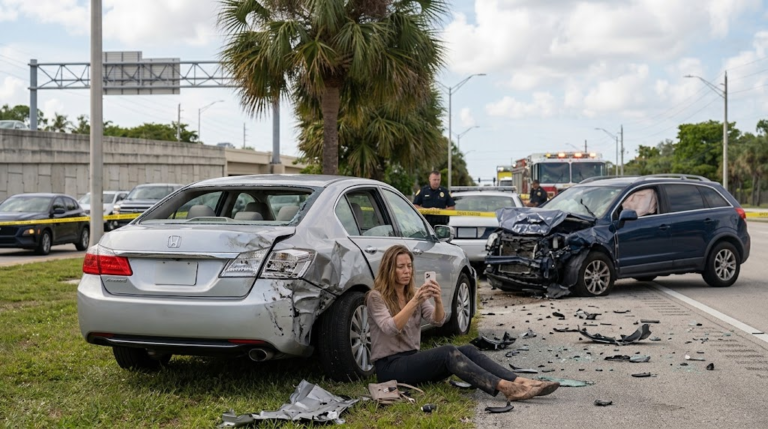
Close-up photos of the USDOT number, MC number, and company name printed on the truck cabin doors or trailer.Impact Damage Angles:
High-resolution photos showing point-of-impact crush damage on both your car and the commercial truck.Roadway Physical Marks:
Images of brake skid marks, gouges in the asphalt, spilled cargo, glass debris, and traffic signals.Witness Contact Information:
Names and phone numbers of motorists, pedestrians, or store clerks who saw the collision occur.
4. Comprehensive Record Keeping and Cautious Communication
Maintain an organized folder containing medical bills, therapy schedules, repair shop estimates, pay stubs showing missed workdays, and a personal journal tracking your physical pain.
When communicating with insurance representatives, stick strictly to known facts.
Avoid giving recorded interviews or signing release forms for the trucking company’s insurance adjuster without legal guidance.
Financial Compensation Categories Available in Commercial Trucking Claims
A thorough injury claim accounts for both your current financial expenses and the long-term impacts of physical trauma.
Economic Damages (Measurable Financial Losses)
Economic damages cover direct out-of-pocket costs resulting from the collision, supported by receipts, medical bills, and payroll records:
Emergency Medical Care:
Hospital ER visits, diagnostic MRIs, surgical procedures, and specialist consultations.Ongoing Rehabilitation:
Physical therapy sessions, chiropractic care, and specialized medical devices.Lost Income and Future Earning Potential:
Paychecks missed during your recovery, along with long-term reductions in your ability to earn a living due to lasting disability.Vehicle Repair or Replacement:
Body shop repairs for your passenger vehicle or market value reimbursement if your car is declared a total loss.
Non-Economic Damages (Quality-of-Life Impacts)
Non-economic damages address the personal human cost of a severe crash:
Physical Pain and Suffering:
Ongoing physical pain, joint stiffness, and chronic nerve discomfort resulting from spinal or orthopedic injuries.Emotional Distress:
Anxiety, sleep disruptions, post-traumatic stress, and driving phobias following a violent collision.Loss of Enjoyment of Life:
Inability to participate in daily hobbies, recreational sports, or family activities you enjoyed prior to the crash.Permanent Disfigurement:
Lasting surgical scars, burn marks, or loss of limb mobility.
Punitive Damages (Punishing Egregious Misconduct)
In rare cases involving extreme recklessness, Florida courts may award punitive damages under Florida Statute § 768.72.
Punitive damages are designed to punish motor carriers or drivers who exhibit gross negligence, such as driving under the influence of drugs or alcohol, intentionally altering driver hours-of-service logs, or forcing drivers to operate trucks with known, dangerous brake failures.
Key Florida Statutes That Impact Your Claim
Navigating a commercial truck injury claim in South Florida requires understanding how specific state laws apply to your case.
| Florida Statute | Legal Concept | Practical Impact on Your Claim |
|---|---|---|
| Fla. Stat. § 627.736 | Florida PIP 14-Day Rule | Requires you to seek an initial medical evaluation within 14 days of the crash to access your $10,000 Personal Injury Protection benefits.. |
| Fla. Stat. § 627.737 | Serious Injury Threshold | Allows you to step outside the no-fault system and sue for pain and suffering if your medical records show permanent injury, severe scarring, or loss of bodily function. |
| Fla. Stat. § 768.81 | Modified Comparative Negligence | Bars financial recovery if you are found to be more than 50% at fault for the crash. If 50% or less are at fault, your payout is reduced by your percentage of blame. |
| Fla. Stat. § 95.11(5)(a) | Statute of Limitations | Sets a strict two-year deadline from the date of the crash to file a personal injury lawsuit in court. |
Under Florida’s modified comparative negligence standard, your recoverable compensation is adjusted based on fault.
For example, if your total damages equal $100,000 and an investigation determines you were 20% responsible, your final recovery is calculated as:
Recoverable Compensation = $100,000 x (100% – 20%) = $80,000
Why Calling 844-324-HURT Protects Your Health and Legal Rights
Managing hospital bills, car repairs, and corporate insurance calls while recovering from a serious truck crash can quickly become overwhelming.
Calling 844-324-HURT puts a dedicated 24/7 statewide helpline on your side immediately.
Here is how 844-324-HURT supports your total recovery:
Immediate Access to Local Medical Specialists:
Connect directly with accredited medical centers and diagnostic imaging clinics in Boca Raton, Delray Beach, and West Palm Beach specializing in auto trauma.Zero Out-of-Pocket Care:
Receive medical checkups and physical therapy under your PIP benefits or a Letter of Protection (LOP), meaning you pay nothing upfront for your care.Vetted Commercial Trucking Attorneys:
Connect with experienced Florida lawyers who know how to issue black box preservation letters and negotiate with corporate trucking insurers.24/7 Bilingual Helpline:
Support is available around the clock in both English and Spanish across Boca Raton and statewide Florida.
Taking Charge of Your Recovery Today
A commercial truck collision on Glades Road, I-95, or Military Trail can throw your routine into chaos, but taking structured action puts you back in control of your health and financial future.
Seek medical attention promptly, document the scene, and ensure you receive an evaluation within the strict 14-day PIP window.
Avoid giving recorded statements to corporate adjusters before getting legal guidance.
You do not have to stand up to corporate motor carriers alone.
A quick call to 844-324-HURT connects you immediately with trusted local medical providers and experienced legal counsel across Boca Raton and throughout Florida.
Call 844-324-HURT today to protect your health, your rights, and your peace of mind.
Frequently Asked Questions
What should I look for when hiring a commercial truck accident attorney in Boca Raton?
Look for an attorney with specific experience handling corporate motor carriers, deep familiarity with FMCSA safety regulations, experience issuing immediate spoliation letters for black box data, and a track record of handling multi-party insurance claims.
Why is black box ECM data so important in a semi-truck crash case?
Electronic Control Modules (ECMs) and ELD tracking devices record critical pre-impact data, including exact travel speeds, engine RPMs, braking force, steering angles, and continuous driving hours. Because trucking companies can overwrite this data within weeks, having an attorney issue an immediate spoliation letter is vital.
Can 844-324-HURT help me get medical care if I do not have health insurance?
Yes. 844-324-HURT connects crash victims with local medical centers that evaluate and treat injuries using your mandatory Florida PIP auto coverage or a Letter of Protection (LOP). Under an LOP, you pay zero out-of-pocket costs upfront, and medical bills are deferred until your case resolves.
What if the trucking company tries to blame me for the collision?
Under Florida’s modified comparative negligence law (Fla. Stat. § 768.81), as long as you are 50% or less at fault, you can still recover compensation, though your payout will be reduced by your percentage of responsibility. Prompt legal investigation helps protect you against unfair attempts to shift blame.
How quickly should I contact an attorney after a truck crash in Boca Raton?
You should contact an attorney as soon as possible after taking care of immediate safety and medical needs. Early legal action ensures crucial physical evidence, black box records, dashcam footage, and witness statements are preserved before they disappear.



 ES
 EN