
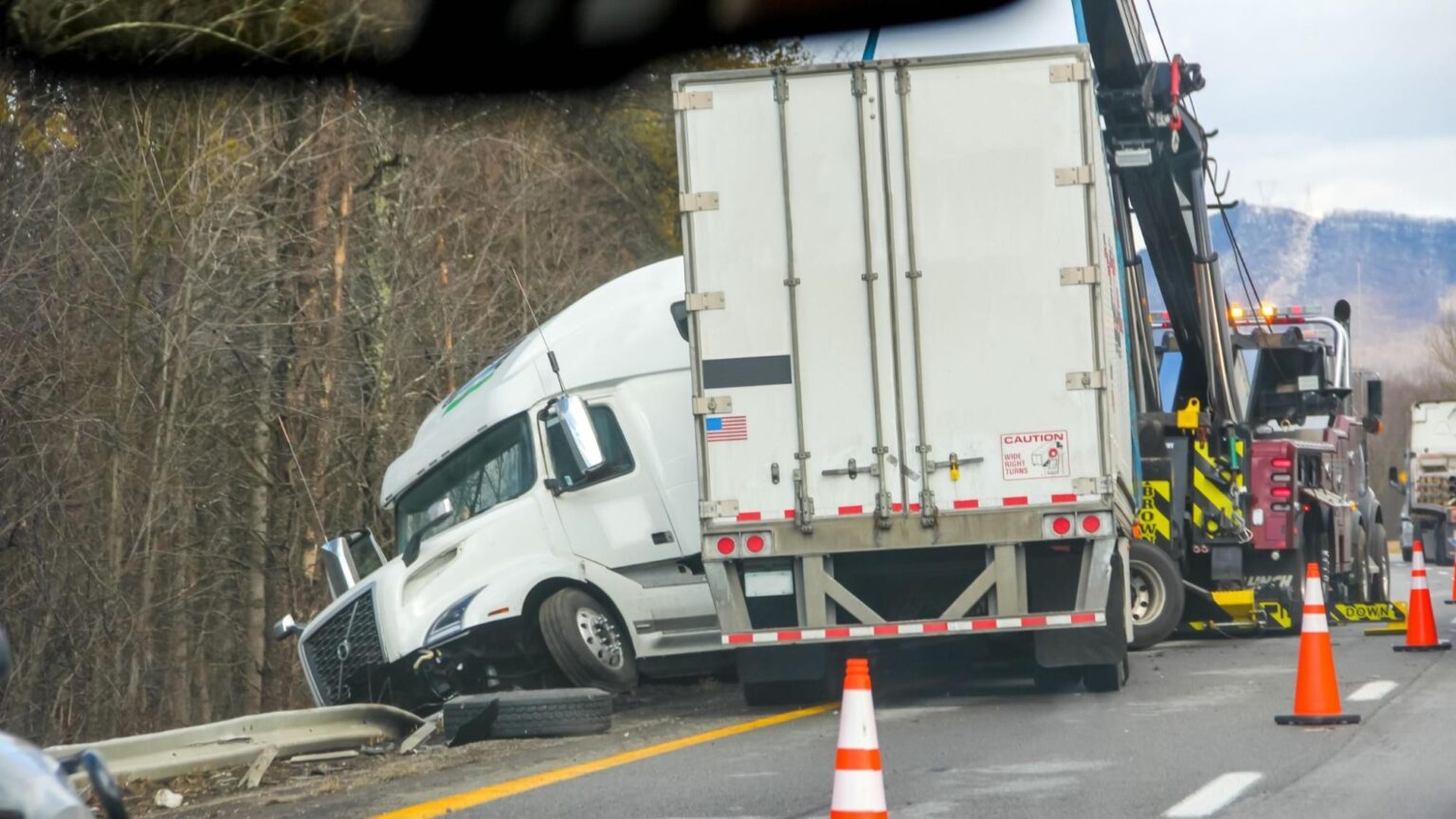
Liability in an Arizona highway pileup involving cars and semi-trucks is shared among multiple at-fault parties based on their exact percentage of responsibility under Arizona pure comparative fault law.
Rather than assigning complete blame to one individual, state courts and insurance adjusters distribute liability across commercial motor carriers, commercial truck drivers, passenger vehicle motorists, and third-party freight loaders whose negligence contributed to the chain reaction.
High-Risk Freeway Hazards and Compounding Impacts
High-speed freight corridors such as Interstate 10, Interstate 17, Loop 101, and Loop 202 witness destructive multi-vehicle collisions every year.
Sudden traffic slowdowns, construction zones, or seasonal monsoon dust storms create situations where drivers lose necessary stopping distance.
An eighty-thousand-pound semi-truck requires significant roadway distance to come to a complete stop, and secondary impacts into passenger cars cause extensive structural crush damage and severe bodily trauma.
The Conflict Between Multiple Insurance Companies
A chain-reaction collision triggers an immediate legal conflict among several insurance carriers. In a standard two-vehicle crash, establishing fault is usually straightforward.
In a multi-vehicle pileup involving passenger cars and commercial carriers, claims adjusters representing corporate fleets, logistics brokers, and private motorists aggressively point fingers at one another to protect their own bottom lines.
What This Guide Covers for Injured Victims
Injured motorists must navigate disputed fault allocations, corporate defense tactics, and competing claims on available insurance policies.
This guide outlines how Arizona comparative fault statutes slice liability, how commercial vehicle accidents differ from standard car crashes, and what electronic black box evidence is necessary to prove which impact caused your physical injuries.
How Commercial Vehicle Accidents Differ from Car Accidents
Many motorists assume that any highway collision follows the same basic insurance rules.
However, accidents involving commercial vehicles operate under an entirely distinct regulatory, financial, and legal framework compared to standard two-car collisions.
Discrepancy in Vehicle Weight and Injury Severity
Passenger cars typically weigh around 4,000 pounds, whereas a fully loaded commercial semi-truck can weigh up to 80,000 pounds.
This enormous difference in mass generates catastrophic physical forces upon impact.
Passenger vehicle occupants involved in commercial crashes face a much higher risk of traumatic brain injuries, spinal fractures, and severe internal trauma than drivers involved in standard passenger car collisions.
Federal Safety Oversight vs. State Traffic Rules
Standard car accidents are evaluated under the Arizona motor vehicle traffic code.
Commercial motor carriers, by contrast, must comply with extensive Federal Motor Carrier Safety Administration (FMCSA) regulations alongside state laws.
These federal rules govern maximum hours of service, electronic logging device tracking, mandatory drug screenings, driver qualification standards, and scheduled fleet maintenance.
A violation of federal trucking safety rules provides strong evidence of corporate negligence.
Multi-Layered Commercial Insurance Policies
Private motorists typically carry basic individual auto insurance policies that meet state statutory minimums.
Commercial motor carriers must carry significantly higher liability coverage under federal mandates.
Additionally, commercial carriers usually maintain multiple layers of insurance, including primary commercial liability, secondary excess coverage, and corporate umbrella policies.
While these higher coverage limits provide substantial resources for catastrophic injuries, they also motivate commercial insurance carriers to defend claims aggressively.
Corporate Rapid Response Teams
Following a standard car crash, insurance adjusters usually review property damage photos and police reports days after the event.
In a major commercial crash, trucking companies frequently deploy rapid response teams of independent investigators, adjusters, and defense attorneys to the crash site within hours.
These corporate teams examine physical evidence, interview witnesses, and inspect roadway marks before injured victims have even left the hospital.
The Anatomy of a Chain-Reaction Highway Crash in Arizona
Chain-reaction highway pileups rarely happen because of a single driving error.
Instead, they develop through compounding mistakes, adverse road conditions, and sudden highway hazards that eliminate safe stopping margins.
Environmental Hazards and Arizona Freeway Corridors
Arizona drivers face unique roadway conditions that contribute directly to major pileups.
During summer monsoon months, sudden dust storms along open rural stretches of I-10 drop visibility to zero in seconds.
Urban corridors like Loop 101 and Loop 202 experience rapid speed changes behind blind overpasses and high-volume interchanges.
When drivers travel too fast for conditions or follow other cars too closely, a minor initial collision quickly escalates into a multi-lane pileup.
The Sequence of Multiple Impacts
The physics of a chain-reaction crash create layered points of impact:
- The Initial Collision: A front vehicle slows down or stops, and a trailing passenger car rear-ends it due to insufficient following distance.
- Secondary Compounding Crashes: Additional passenger cars brake hard, swerve across lanes, or collide with median barriers while attempting to avoid the initial crash.
- The Heavy Commercial Impact: A commercial semi-truck, requiring much longer stopping distances than passenger cars, crashes into the stopped queue from behind, causing massive crush damage.
- Lateral Chain Reactions: Crushed passenger cars are shoved into adjacent lanes, sideswiping other vehicles and blocking highway emergency shoulders.
Because each collision within the pileup happens in fractions of a second, establishing the exact sequence of events becomes a central dispute among the insurance adjusters involved.
Dividing Fault Under Arizona Pure Comparative Negligence (A.R.S. § 12-2505)
Civil courts and insurance companies do not treat fault in a multi-vehicle pileup as an all-or-nothing proposition.
Arizona applies the legal standard of pure comparative fault to determine financial responsibility.
How Comparative Negligence Operates in Multi-Vehicle Claims
Under Arizona Revised Statutes § 12-2505, an injured individual retains the right to recover compensation even if they share partial responsibility for the collision.
Unlike states that bar financial recovery if a victim is half or mostly at fault, Arizona allows compensation regardless of your percentage of fault.
However, your total financial recovery is reduced in direct proportion to your assigned share of blame.
How Insurers Use Fault Disputes to Shift Blame
Commercial insurance adjusters routinely use comparative negligence to minimize their payouts.
In a multi-vehicle crash, the semi-truck’s insurance carrier will argue that earlier passenger car drivers created the underlying hazard by following too closely or stopping abruptly.
By distributing small percentages of fault across several different motorists, the commercial insurer attempts to reduce its overall payment obligation.
Example of Fault Distribution in an Arizona Highway Pileup
| Party Involved in the Pileup | Primary Action or Contributing Factor | Assigned Share of Fault | Practical Impact on Financial Responsibility |
|---|---|---|---|
| Commercial Motor Carrier | Excessive speed for conditions and driver fatigue violations | 60% Fault | Responsible for paying 60% of total proven damages. |
| Preceding Passenger Car Driver | Tailgating and sudden braking without warning | 25% Fault | Responsible for paying 25% of total proven damages. |
| Injured Claimant | Traveling slightly above the weather-safe speed flow | 15% Fault | Claimant's final compensation is reduced by 15%. |
Under this legal framework, if an injured driver successfully proves their losses, their ultimate payout reflects their total damages minus their 15% share of fault.
A qualified truck accident attorney works to challenge unfair fault allocations, ensuring that commercial motor carriers cannot push their responsibility onto injured passenger car drivers.
The Nonparty at Fault Defense (A.R.S. § 12-2506)
Corporate defense attorneys handling commercial truck claims frequently rely on Arizona’s statutory nonparty at fault defense under A.R.S. § 12-2506.
This legal rule allows a defendant to point fingers at absent parties.
The “Empty Chair” Tactic Explained
Under this statute, a defendant can formally designate nonparties who allegedly contributed to the collision, even if those parties were never identified by police or named in a lawsuit.
Defense attorneys may point to:
- The unknown driver of a phantom vehicle that allegedly caused the initial slowdown and fled the area.
- Other passenger car drivers who were involved in minor collisions moments before the commercial truck arrived.
- Government transportation agencies for alleged deficiencies in weather warnings or highway maintenance.
When a case proceeds to trial, the jury can assign a percentage of fault to this empty chair.
Any fault assigned to a nonparty directly reduces what the named commercial carrier must pay to the injured plaintiff.
Why Identifying Every Potential Defendant Early Is Essential
Defeating this defense strategy requires a comprehensive initial investigation.
An experienced car accident attorney must identify and name every motorist, freight contractor, and corporate entity as a formal party early in the process.
This proactive approach prevents defense counsel from deflecting liability onto unnamed parties later in the case.
Insurance Policy Hierarchy and the Order of Pay
A serious hazard in a major highway pileup is policy dilution.
When numerous drivers and passengers suffer severe injuries in a single collision, available insurance coverage can be strained.
The Risk of Policy Dilution in Large Pileups
Basic personal auto insurance policies carried by private motorists offer limited coverage for severe, multi-person injuries.
If several passenger cars share fault, their individual policies may provide only minimal relief when divided among multiple injured claimants.
Commercial semi-trucks, however, carry substantial primary liability coverage, frequently supplemented by commercial excess and umbrella policies.
The Order of Insurance Payouts in Multi-Vehicle Claims
Sorting through competing claims across several insurance carriers follows a structured sequence:
| Priority Level | Insurance Coverage Tier | Role in Multi-Vehicle Highway Claims |
|---|---|---|
| Primary Commercial Policy | The motor carrier's main commercial liability coverage | Serves as the primary source of recovery for severe trauma caused by the commercial truck. |
| Corporate Excess / Umbrella | Secondary commercial insurance layers | Activates when total claim values exceed the limits of the motor carrier's primary policy. |
| Private Auto Liability Policies | Personal insurance carried by at-fault passenger car drivers | Provides supplemental recovery for secondary impacts caused by other individual motorists. |
| Underinsured Motorist (UIM) | The injured victim's own personal auto insurance policy | Covers remaining financial gaps if at-fault policies are exhausted by other injured victims. |
When total losses exceed all available insurance limits, insurance companies sometimes file an interpleader action, depositing policy funds with the court and asking a judge to divide the money among the victims.
Securing prompt legal representation ensures your medical documentation is prepared before insurance funds are exhausted.
Forensic Evidence: Proving Which Impact Caused Your Injuries
Commercial defense attorneys in multi-vehicle crashes often claim that a victim’s physical trauma resulted from an earlier impact with a passenger car rather than their client’s semi-truck.
Refuting this argument requires objective scientific evidence.
Digital Black Boxes and Vehicle Telematics
Commercial trucks and modern passenger vehicles maintain electronic data recorders that log vital pre-crash metrics:
- Commercial Electronic Control Modules (ECMs): Heavy semi-trucks feature ECM systems that track travel speed, engine RPMs, throttle position, and brake pedal application in the seconds before impact.
- Passenger Car Event Data Recorders (EDRs): Passenger vehicles record changes in velocity, seatbelt tensioner activation, and airbag deployment times.
- Electronic Logging Devices (ELDs): Commercial fleets log driving hours, rest breaks, and vehicle locations, revealing whether driver fatigue contributed to the collision.
Accident Reconstruction and Biomechanical Analysis
Experienced attorneys collaborate with forensic accident reconstructionists to reconstruct the timeline of the pileup.
By matching ECM data with roadway physical evidence like paint transfers, skid marks, and crush depth measurements, experts establish the exact sequence of collisions.
Biomechanical specialists then correlate the physical forces generated by the commercial truck’s impact with the victim’s medical records, proving that severe spinal or head injuries resulted from the heavy commercial collision rather than a minor preceding impact.
Immediate Preservation Through a Spoliation Letter
Commercial motor carriers routinely overwrite electronic logging data and black box records within 7 to 30 days during normal business operations.
A skilled truck accident attorney sends an immediate, formal Spoliation of Evidence letter to the motor carrier, its insurance company, and maintenance vendors.
This legal notice mandates the preservation of all electronic data, dashcam footage, and vehicle components, preventing the loss of critical evidence.
Critical Steps to Take After an Arizona Highway Pileup
The moments following a major highway pileup are dangerous and chaotic.
Taking methodical steps protects your personal safety and preserves essential evidence for your claim.
1. Ensure Scene Safety and Call Emergency Dispatch
Remaining inside your vehicle with your seatbelt fastened is often the safest choice if your car is disabled in active travel lanes during a dust storm or heavy traffic.
Stepping onto an active interstate carries a high risk of being struck by secondary traffic.
Call 911 immediately to report your location, highway milepost, and the presence of commercial trucks so emergency responders can secure the scene.
2. Gather Physical and Digital Evidence
Use your smartphone camera to photograph the scene once emergency personnel confirm it is safe to do so.
Photograph commercial truck door markings, USDOT registration numbers, company names, license plates, and point-of-impact damage on all involved vehicles.
Collect contact details from independent witnesses before they leave the area.
3. Decline Recorded Statements to Insurance Adjusters
Representatives from multiple insurance companies will contact you shortly after the crash.
Politely decline to provide recorded statements or speculate about vehicle speeds, the sequence of collisions, or your injuries until you speak with an attorney.
Early recorded statements can be used to shift fault onto you.
4. Obtain a Prompt Medical Examination
Adrenaline and shock routinely mask severe physical trauma for hours or days after an impact.
Seeking an immediate medical evaluation at an emergency clinic or specialized accident center establishes a documented link between the collision and your injuries, protecting your health and your legal rights.
How 844-324-HURT Connects You with Medical Care and Legal Advocacy
Dealing with painful physical injuries while managing calls from several insurance carriers is overwhelming.
Comprehensive Recovery Support Under One Network
Our network supports your recovery through three vital services:
- Direct Access to Accredited Medical Providers: We connect you with local medical centers, orthopedic specialists, and diagnostic imaging clinics across Arizona that specialize in auto collision injuries.
- Medical Care with Zero Upfront Costs: We coordinate your medical treatment under available auto insurance coverages or an Attorney Lien (Letter of Protection), ensuring you pay no out-of-pocket expenses while your legal claim is pending.
- Vetted Commercial Accident Attorneys: We match you with proven personal injury attorneys who understand complex Arizona highway litigation, know how to issue spoliation notices, and have the resources to take on large commercial motor carriers.
Taking Control of Your Highway Pileup Claim
A multi-vehicle chain reaction on an Arizona highway can disrupt your life in an instant. Protecting your future requires prompt medical care, thorough evidence gathering, and strategic legal guidance.
Act quickly to preserve scene evidence, avoid premature insurance statements, and obtain a complete medical evaluation.
Early legal intervention ensures that vital commercial black box data and driver logs are preserved before they are lost.
You do not have to confront corporate trucking companies and multiple insurance adjusters on your own.
A single call to 844-324-HURT connects you directly with trusted medical providers and experienced car accident attorneys ready to protect your rights.
Call 844-324-HURT today to begin your physical and financial recovery.
Frequently Asked Questions
How is responsibility divided when multiple vehicles crash during an Arizona dust storm?
Fault is assigned proportionately among all involved motorists under Arizona’s pure comparative fault statute (A.R.S. § 12-2505). Crash reconstruction specialists and attorneys examine electronic black box data, vehicle crush angles, and witness accounts to determine each driver’s degree of responsibility based on speed and following distance.
What happens if multiple victims make claims against the same commercial truck insurance policy?
When numerous injured individuals file claims against a single commercial policy, the available coverage must be shared among all claimants. If total losses exceed the primary policy limits, attorneys pursue additional recovery through the motor carrier’s excess or umbrella policies, or through the victims’ own Underinsured Motorist (UIM) coverage.
Can an injured driver pursue claims against more than one insurance policy after a highway pileup?
Yes. If multiple motorists contributed to the chain reaction, you can file simultaneous claims against each at-fault driver’s insurance policy, as well as the commercial trucking company’s coverage. Each insurer contributes to your settlement based on its policyholder’s assigned share of fault.
How do accident reconstruction specialists determine which impact caused specific injuries?
Forensic engineers analyze Event Data Recorder (EDR) metrics from all vehicles, calculating the change in velocity (delta-V) produced by each collision. Medical doctors and biomechanical experts then review these force calculations alongside your clinical imaging to confirm which impact caused specific spinal, joint, or head injuries.
What is the legal deadline to take action after a multi-vehicle highway crash in Arizona?
Under A.R.S. § 12-542, the statute of limitations for personal injury claims is two years from the date of the collision. If a government entity shares responsibility for road maintenance or inadequate warnings, a formal Notice of Claim must be served within 180 days. However, commercial vehicle telematics and black box records must be preserved through a spoliation letter within days of the crash.




 EN
 ES